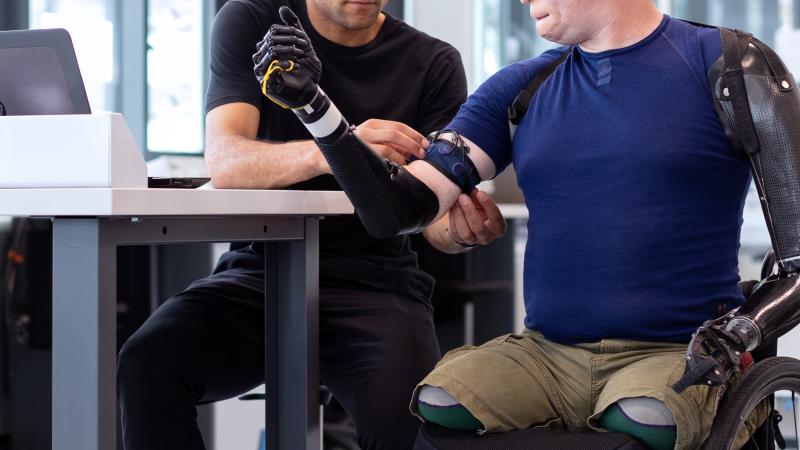
A fashion model with prosthetic legs… a musician who can’t hear… a writer who can’t see. Instead of disabled, differently-abled, handicapped – why not better-abled?Read more

Intelligent. Optimistic. Curious.
Episode Archives

Words can change lives. Just look at the “at-risk” students in Erin Gruwell’s class. Many of them were branded “unteachable.” Then they read Anne Frank’s diary, and started to keep their own journals. The experience was electrifying. In this hour of To the Best of...Read more
Who are you?
A man? A woman?
Are you a success? A failure?
A parent? An athlete? A wallflower?
A Christian? A Buddhist? A baker?
If we are only a collection of stories about ourselves... what's the truth of who "we" are?
Looking for UNCUT...Read more
These days it seems we just can’t get enough of it. Over the past few years, luxury spending in the United States has been growing four times faster than overall spending. We’re spending more money on more products and services that we don’t really need – like Evian bottled water and Prada...Read more
Cameron Sinclair has something to say to architects out there: design like you give a damn. The founder of Architects for Humanity says the houses and office buildings we build today will literally shape the world our children inherit. So give a damn. In this hour of To the Best of Our...Read more
Eighty per cent of Americans say they believe in heaven. But when they're asked to describe it, many are at a loss for words. Do they think that there's another universe in the sky or do they believe that heaven is something more abstract and metaphorical? We'll explore our enduring fascination...Read more
Do you ever have a right to kill? What about Israeli agents who assassinate Hamas leaders? Or suicide bombers who blow up their enemies? Do the ends justify the means? William Vollman has written a three-thousand page treatise on the morality of violence. In this hour of To the Best of Our...Read more
What if our lives were like DVDs? What if we had alternative endings to look forward to, instead of death? We explore our lust for immortality. And we look at the many alternative endings that Ernest Hemingway wrote for his classic novel, "A Farewell to Arms."
A rose is a rose is a rose... until it becomes perfume. In this hour of To the Best of Our Knowledge, the power of the flower. A science journalist introduces us to Luca Turin, the most amazing nose in the business, with a new theory about how we smell. We’ll talk with photographer Joyce...Read more
Everybody gets excited about whatever's new, but what about what's really, really old? In this hour of To the Best of Our Knowledge we commemorate geologic time. We'll meet the scientists who found the oldest object on Earth - a three point four billion year old zircon! And the Jazz...Read more

Why do people embrace the experimental visual art of Mark Rothko but avoid the experimental music of Karlheinz Stockhausen? That's the question that David Stubbs explores in his book, "Fear of Music." We'll meet Stubbs in this hour of To the Best of Our Knowledge. Also,...Read more
As artists and scientists explore the edges of our senses, what we touch, taste, see, smell, and hear is changing.
In this hour we hear from a psychiatrist who’s using touch to help people recover from trauma, investigate a mysterious sensory experience that gives some people euphoric...Read more
Kayfabe is an old carny term for fakery. Now it’s the code of honor for professional wrestling. Kayfabe means you never, EVER admit to ANYONE under ANY circumstances that pro wrestling’s fake. In this hour of To The Best Of Our Knowledge - the spectacle of professional wrestling. We’ll talk real...Read more
Investigative journalist Seymour Hersh made his name when he broke the story of the My Lai Massacre. Looking back you have to wonder: why did Lt. William Calley tell Hersh he’d killed hundreds of Vietnamese civilians? On this hour of To the Best of Our Knowledge Hersh says “because I asked him...Read more
A rose by any other name may smell as sweet, but you still need a word to describe that glorious smell. We'll try out new words from the online world with a New York Times language blogger - words like YakkaWow and suicide cuisine. Also, the rise of a new world language called Globish....Read more
With the emergence of barefoot running, the sport suddenly is red hot again. But barefoot or not, are human bodies really born to run? We'll check in on the science or runner's high this hour, and try to unlock the secrets of the Kenyans - the fastest people on earth. Also, Olympic medalist...Read more
Jacques Derrida and the philosophical movement known as deconstruction were once the rage on college campuses. Those days have passed, but deconstruction's influence is everywhere. We talk with Gayatri Chakravorty Spivak, who first translated Derrida's landmark book "Of Grammatology" into...Read more

Does anyone still hitchhike? Cult film director John Waters does. At the age of 66, he hitchhiked 2,800 miles, from Baltimore to San Francisco. He tells us about the people who picked him up, along with some who didn't. And did the America Interstate System pave the way...Read more
Many Americans think the story of Cuba begins and ends with Fidel Castro. But the soul of the Cuban Revolution belonged to the charismatic, Romantic guerilla hero Ernesto “Che” Guevara. To the Best of Our Knowledge revisits the Sixties and counts the private costs of that era’s social gains. ...Read more
Forget the deerstalker cap and the calabash pipe. The real Sherlock Holmes is much hipper than that. One scholar suggests that with his violin, creative spirit, cocaine and costumes, Holmes was the rock star of his day. We'll investigate the elementary Sherlock Holmes, from the new annotated...Read more
What’s the face of the future? Not flying cars and life on Mars… What’s the future of our faces? With new facial transplantation surgeries and the latest news about the NSA collecting images for facial recognition anaylsis, we're wondering about what we see in the mirror every day.
Also...Read more
“The medium is the message.” “We shape our tools and thereafter our tools shape us.” “We look at the present through a rear-view mirror. We march backwards into the future.” Those are just a few of Marshall McLuhan’s famous quotes. McLuhan is one of the most influential media thinkers of...Read more
Whittier called them "the saddest words: it might have been." But turn it around and you'll find places we create to replace the world we live in -- past, present and future. On To the Best of Our Knowledge, other worlds. Scientist Brian Greene looks at the physics of the multiverse, and...Read more
Ingrid Betancourt was kidnapped by Marxist rebels in Columbia while in the midst of her presidential campaign. She spent the next six and a half years in captivity chained, humiliated and abused. But her greatest fear was not death. It was losing her humanity. In this hour of To the Best of Our...Read more